

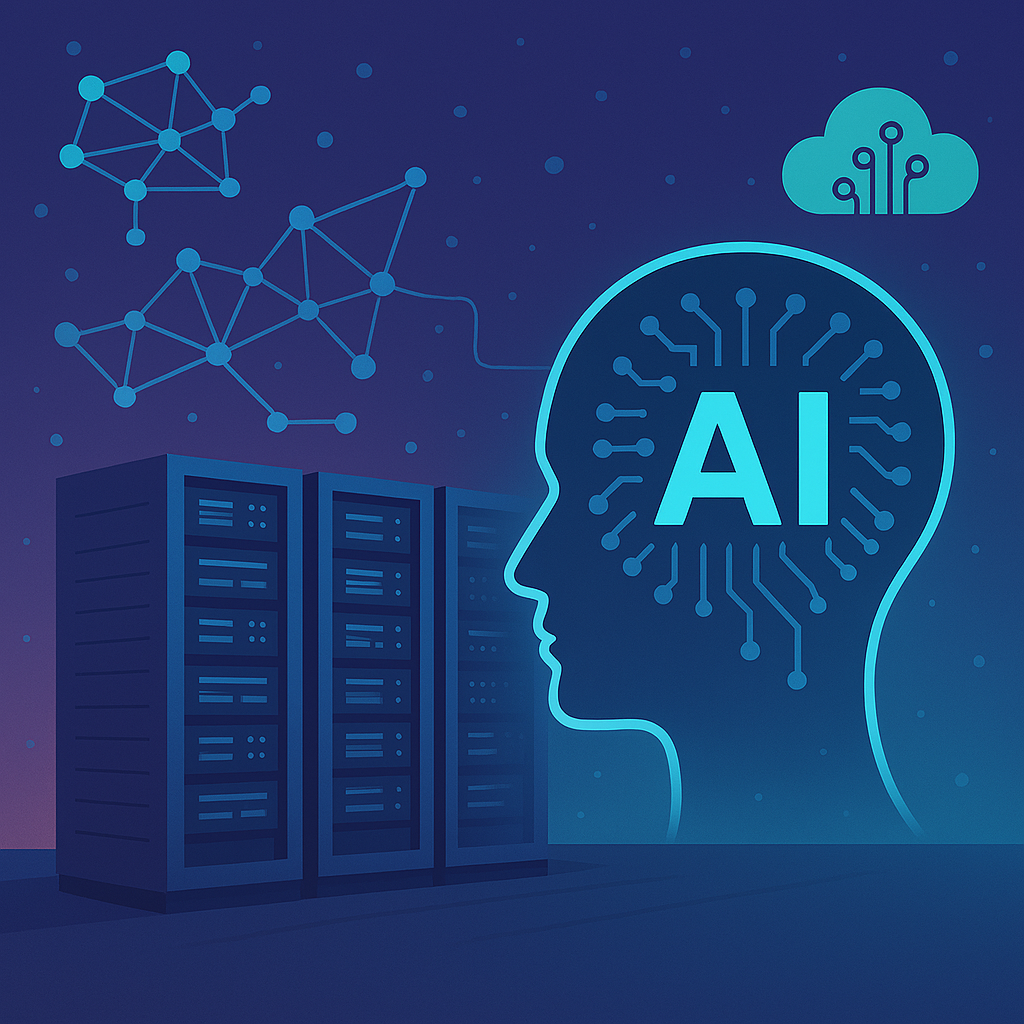
Artificial Intelligence is becoming established as the driving force of the new digital revolution. From language models to digital twins, not forgetting predictive analysis, AI requires colossal volumes of data and unprecedented computing capacity. This transformation is disrupting an essential link in the chain of the digital economy: data centres. Faced with the exponential growth in power requirements and efficiency, data centers are being reinvented in response to an era dominated by algorithms.
Data Centres in the AI era: a new generation of infrastructure
A data centre dedicated to artificial intelligence doesn’t just stand out by its size or energy consumption, but by its capacity to handle extremely intensive workloads. The training of AI models, whether based on machine learning or deep learning, requires a far greater computing density than traditional environments. GPUs (Graphics Processing Units) and TPUs (Tensor Processing Units) are becoming the essential drivers of these infrastructures, capable of performing billions of operations in parallel.
To support these needs, the design of AI datacenters is based on optimized architectures: reduced latency thanks to optical fibre, redundant electrical power supplies, and super-fast networks. Operators are also relying on innovations in cooling — whether liquid, immersion or hybrid cooling — to maintain optimal performance while controlling energy consumption.
Big players such as Microsoft, Google or Nvidia are massively invested in data centers dedicated to AI, often located near energy basins or areas with a favourable climate. In Europe, many projects are taking shape, showing the desire for digital sovereignty and the surge in AI research on the continent.
When AI takes a hand in operations: towards smart data centers
Beyond hardware infrastructures, Artificial Intelligence is also transforming the everyday management of datacenters. Thanks to AIOps (Artificial Intelligence for IT Operations), systems may now anticipate faults, optimize load distribution and adjust power consumption according to activity peaks. This automation makes it possible to reduce operating costs and improve the availability of services in real time.
AI workloads are also introducing new demands: large language models, complex simulations, continuous data flow analysis…These operations require highly scalable environments, capable of simultaneously managing billions of transactions and processes. The hybrid cloud, combining the flexibility of the public cloud and the security of the private cloud, is coming to the fore as a response to the growing needs of businesses.
Performance and sustainability: the dual requirement of AI data centres
AI datacentres are faced with a major challenge: reconciling computing power and sustainability. Each training of a model consumes a significant amount of power, and the power density of racks is reaching unprecedented levels. Operators must therefore innovate to maintain exemplary levels of power usage effectiveness (PUE).
Liquid or immersion cooling technologies can reduce the need for conventional air conditioning, while increasing the computing density per square metre. Similarly, heat recovery and the use of renewable energy are becoming essential tools to offset the environmental impact of AI.
Some datacentres re-inject their heat into urban networks, while others are experimenting with natural cooling systems based on the circulation of cold water or on geothermics. These innovations are positioning AI data centers as key players in the digital energy transition.
A changing market: Europe, France and prospects by the year 2030
The global AI infrastructures market is undergoing unprecedented acceleration. According to the estimates of the European Union, investments in specialist data centers could double between now and 2030. Europe intends to assert its digital sovereignty by developing strategic technology hubs on its territory, capable of competing with the American and Asian giants.
France, with the strength of its geographical position and its pro-decarbonization policies, is positioned as an El Dorado for next-generation infrastructures. Areas like Île-de-France, Nord or Bouches-du-Rhône are already the focus of a large share of the investment, while new projects are emerging around edge computing and energy sharing.
The next few years will see the rise of more responsible and resilient models, with performance being measured not only in teraflops, but also energy efficiency and a controlled carbon footprint.
AI datacenters: the cornerstones of the new digital era
Artificial Intelligence is redefining the rules of the digital game. To sustain this revolution, data centers are evolving into infrastructures which are simultaneously more powerful, smarter and more responsible. From design to operation, each innovation aims to combine performance, security and sustainability.
In Europe, this change comes with a clear ambition: to strengthen digital sovereignty while boosting the ecological transition. Operators must rethink their models and invest in solutions capable of combining computing power and energy efficiency.
A major player in this transformation, Data4 designs and operates next-generation datacentres, capable of meeting the increasing needs of AI models while respecting environmental imperatives. With its highly connected, resilient and sustainable infrastructures, Data4 is taking centre stage as a European cornerstone of the responsible digital economy.